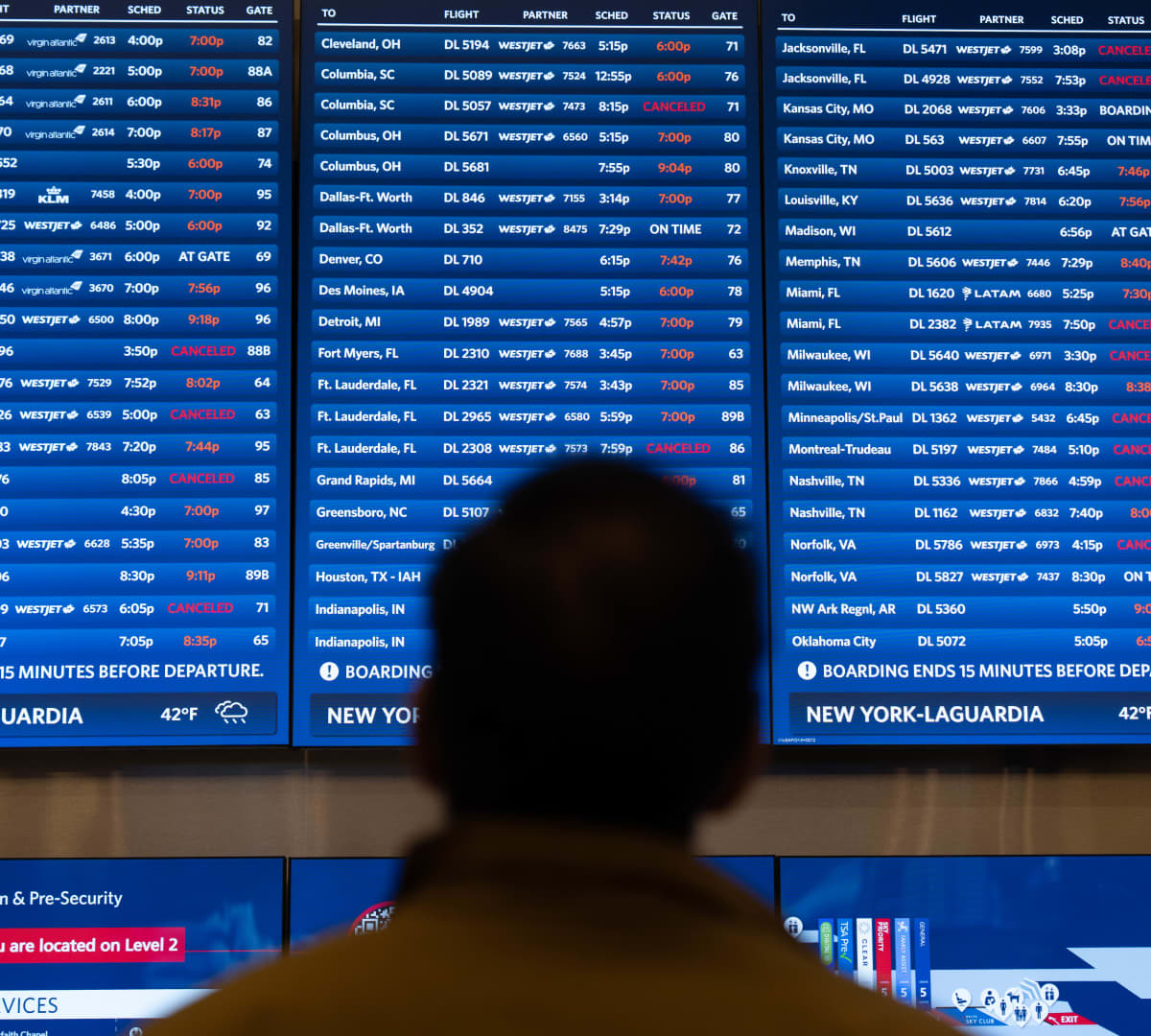
The Federal Aviation Administration's ground stop on Friday that halted U.S. departures for more than four hours created lingering disruptions through Sunday, though airlines expect operations to return to near-normal levels on Monday.
As of 4:45 p.m. ET on Sunday, close to 2,000 U.S. flights were canceled and more than 7,500 were delayed, according to FlightAware. This marked improvement from Saturday's 6,697 cancellations and 9,000 delays.
American Airlines led cancellations on Sunday with 805 flights, representing about 13% of its schedule. Delta Air Lines canceled 360 flights, or 7% of its schedule, with both airlines' major hubs experiencing severe delays. JetBlue Airways canceled close to a third of its flights.
Transportation Secretary Sean Duffy tied the outage to a router failure during work to upgrade from copper wire infrastructure, overseen by L3Harris Technologies, to fiber-optic systems. FAA administrator Bryan Bedford called the upgrades part of "routine" maintenance. L3Harris said in a statement it was supporting the FAA's investigation.
Airlines waived change fees and offered pilots and flight attendants extra pay. Passengers reported being booked on multiple flights before finally departing, with some sleeping in airports or making detours of hundreds of miles.
Shortly after the ground stop, Duffy pushed Congress for as much as $50 billion for upgrades to the aging air traffic control system. Democratic lawmakers from the House Committee on Transportation and Infrastructure said Congress had already approved $12.5 billion for airport and air traffic control improvements over five years and cited unspent money from existing funding.
Airlines most affected include American Airlines (AAL), Delta Air Lines (DAL), and JetBlue Airways (JBLU). Investors should monitor airline operational capacity and any further FAA infrastructure-related disruptions.