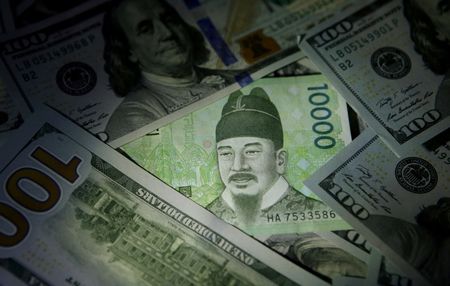
South Korea's currency strengthened to a 2.5-month peak following better-than-expected GDP data that lifted expectations for Bank of Korea rate hikes. The won climbed against the dollar as investors repriced monetary policy odds in the world's 10th-largest economy.
The GDP beat triggered a rally in the won/dollar pair reversing recent weakness. Stronger economic growth removes headwinds for rate hikes, which the BoK had previously held steady at 3.25 percent. Market pricing now reflects higher odds the central bank tightens policy at its next decision, making won-denominated assets more attractive to carry traders and foreign investors seeking higher yields.
The GDP surprise matters because South Korea faces persistent inflation pressures and a weakening currency that imported price pressures into the economy. The BoK kept rates unchanged most recently despite inflation running above target, prioritizing financial stability in a housing market burdened by debt. Stronger growth data gives the central bank cover to abandon its cautious stance.
Currency strength creates a hawkish feedback loop. A stronger won reduces import costs and cooling inflation, which theoretically supports the case for higher rates. But sustained won appreciation also hurts South Korean exporters including chip giant Samsung Electronics and automakers like Hyundai Motor, which rely on price competitiveness in global markets. A 5 percent won appreciation erodes export margins materially.
The BoK faces a policy tightrope. Rate hikes push the won higher, protecting financial stability and import prices but hammering the export sector that drives 40 percent of GDP. The central bank must balance household debt concerns against growth preservation and currency stability.
Foreign investors rotated into won assets on the rate hike repricing, driving the currency move. If the BoK does hike at its next meeting, the won could extend gains, pressuring Samsung, Hyundai, and other export-dependent companies reliant on currency tailwinds for profit margins. Conversely, if the GDP beat proves temporary and growth stalls, rate hike expectations deflate and the won reverses.
South Korea's trade data and inflation readings over the next two months will determine whether the BoK commits to tightening or pivots back to accommodation.
KRW/USD, Samsung Electronics (005930.KS) and Hyundai Motor (005380.KS) face the most direct exposure to won strength and BoK policy shifts. Monitor the next BoK monetary policy decision and Q3 export volumes for directional clues.